When I joined Cumberwell Park, I decided to spend some time playing from the Purple tees, which were previously the Yellow tees, rather than immediately worrying about playing farther back.
Part of the reasoning was straightforward. I had several new courses to learn, and playing slightly farther forward seemed a sensible way of discovering where the trouble was, understanding the angles into the greens and gradually working out how I wanted to play each hole.
There was another reason that interested me more.
I had heard the suggestion that playing forward tees could help a golfer learn how to shoot lower scores. After approximately 25 years of playing golf without ever breaking par for 18 holes, despite getting very close on numerous occasions, I thought there might be something in the idea.
Initially, the concept seems rather obvious. A shorter golf course should produce shorter approaches, more realistic birdie opportunities and, presumably, lower scores. That doesn’t really tell us anything particularly useful.
After trying it for myself, though, I think there may be something else going on.
We spend a lot of time practising the golf shots required to shoot lower scores, but how often do we actually practise shooting the score itself?
We Practise Golf Shots, But Do We Practise Scoring?
If somebody is trying to break 80, they might work on their driver, practise putting, improve their wedge play and perhaps have some lessons.
All of those things can make them a better golfer, but if their normal score is somewhere in the mid-80s, how often do they actually reach the 16th tee with 79 genuinely available?
Probably not very often.
When that opportunity eventually arrives, we suddenly expect ourselves to know how to deal with a situation we have barely experienced.
The golf shots themselves haven’t changed. A six-foot putt is still a six-foot putt and a 150-yard approach is still a 150-yard approach, but they don’t necessarily feel the same when we attach a particular score to them.
I know this because I have spent years doing exactly that.
I Had Already Proved I Could Play Under Par
Long before I finally broke par for 18 holes, I had plenty of evidence that the golf required to do it was there.
At Wrag Barn, I once played the back nine in four under par. It was an awesome nine holes of golf, although I remember being gutted because I had shot seven over on the front.
At Broome Manor, I once went five under par for a four-hole stretch and somehow still managed to finish the complete round six over.
Perhaps the best example came at The Manor House, where I stood on the 15th tee two under par. I had already played 14 holes below par and was exactly where I needed to be.
I finished the round with two double bogeys and a bogey to shoot 3 over par.
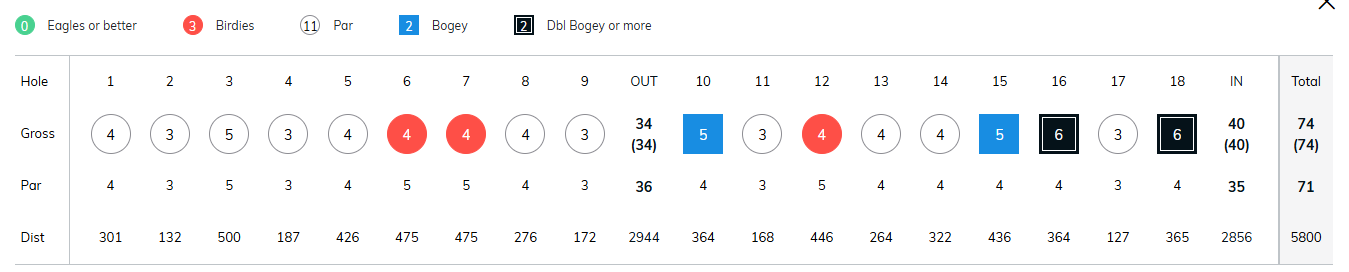
There have also been plenty of rounds where I have finished one over par and other occasions when I have reached the closing holes one or two under.
The evidence was therefore difficult to argue with. I could make birdies and I could play extended periods of golf below par.
What I couldn’t seem to do was put enough of it together for 18 holes and then get out of my own way when I realised what I was about to achieve.
Being Under Par Changed the Way I Played
If I was one under after six holes, I could generally carry on playing because there was too much of the round remaining to attach much significance to the score. If I was one or two under with two or three holes remaining, things could become very different.
I would become conscious of what I was doing. Instead of simply choosing a club, picking a target and making a swing, I could start thinking about what the shot meant for the score.
My body could become a little tighter and decisions that would normally be straightforward suddenly required more thought.
That isn’t necessarily a swing problem.
It may be an experience problem.
If I only find myself in that position once or twice a year, I am asking myself to become comfortable with something that is inherently unfamiliar. Playing forward appeared to offer a way of changing that.
Rather than waiting for an exceptional round to provide another opportunity, perhaps I could deliberately create more situations where a low score was available.
Perhaps I could practise scoring.
Why I Started Playing From the Forward Tees
My initial reason for playing the Purple tees was still to learn Cumberwell. I don’t know exactly when I will move farther back and, at the moment, I don’t think I need to decide.
The tees I’m playing are serving a purpose.
I’m learning where to miss, which holes offer genuine scoring opportunities, where the trouble is and which clubs give me the best position for the next shot. At the same time, I’m putting myself into situations where being around par is realistic.
That second part has become increasingly interesting.
I’ve watched YouTube videos of Bryson DeChambeau talking about using forward tees in a similar way, deliberately putting himself in positions where shooting very low scores became possible so that being well under par became more familiar.
I’m obviously not comparing my golf with Bryson’s. The relevant part is the principle.
If being under par creates pressure partly because the situation is unfamiliar, perhaps one way of reducing that pressure is to make the situation less unusual.
Playing Forward Tees Doesn’t Automatically Make You a Better Golfer
There is an obvious objection to all of this.
If I move forward, the golf course becomes shorter and I should shoot lower scores.
Of course.
I have no interest in pretending that a score from one set of tees is necessarily equivalent to exactly the same number from significantly farther back. Different tees change the length of holes, the clubs required for approaches and sometimes which hazards are in play.
That isn’t what I’m trying to achieve.
There is an important difference between moving forward and saying, “Look how good my score is”, and moving forward with the intention of creating a situation where the score I’m trying to shoot is genuinely available.
The first is about the number.
The second is about experiencing what happens when the number becomes possible.
If I’ve been trying to break 80 for years, perhaps there is some value in standing on the 16th tee with 76 or 77 genuinely available more than once every six months.
- What happens to my decisions when I get there?
- Do I become defensive?
- Do I start steering shots?
- Do I suddenly stop trusting clubs I’ve been hitting well all day?
Those are things I can’t really learn on the driving range.
Can You Practise Shooting Lower Golf Scores?
We practise almost everything else in golf.
If my bunker play is poor, I can find a practice bunker and hit bunker shots. If I struggle from 50 yards, I can practise from 50 yards. If my putting is costing me shots, I can spend time on the putting green.
There is no equivalent practice ground for standing on the 17th tee with your best-ever score in your hands.
The only way to experience that is to play golf and put yourself in that position.
Forward tees potentially increase the frequency with which that can happen.
A golfer trying to break 100 could choose tees where shooting somewhere in the 90s is realistically available if they play reasonably well.
Somebody trying to break 90 could create more opportunities to experience closing a round in the 80s, while a golfer trying to break 80 might choose tees that produce more short and mid-iron approaches and put a score beginning with seven genuinely within reach.
The point isn’t to claim that the resulting score proves anything about what you would have shot from another tee.
The point is to experience the process of shooting it.
What Happened When I Played the Forward Tees
My early rounds at Cumberwell were encouraging.
I played the Yellow course from the Purple tees and shot level par, then played the Orange course and shot two over.
Neither round broke the barrier, but scores around par were beginning to feel more normal.
Then I finally broke par for the first time and broke 70 at the same time.
After approximately 25 years of playing golf, I had completed an 18-hole round below par. I made six birdies during the round and didn’t actually realise there had been six until I looked back at the scorecard afterwards.
The closing three holes provided a particularly useful test because I stood on the 16th tee three under par, exactly the sort of situation where I had got in my own way before.
I then hit my worst drive of the day.
The 16th was a par 5, so I hit a 6-iron back into position and left myself a good downhill third shot. I fatted that, got a fortunate bounce over a bunker and watched the ball roll down the hill to about six feet.
I made the birdie putt.
On the 17th I hit a great drive, fatted the approach onto the green, ran a 40-foot putt about five feet past and made the downhill putt coming back for par.
I reached the 18th tee four under and finally became indecisive. I chose a 7-iron into a short par 3 directly into the wind, came up short, became slightly defensive around the green and eventually made bogey.
I was disappointed and elated at exactly the same time, but the important part was that I had finally finished an under-par round.
Perhaps more importantly, I had learned that I didn’t need perfect golf to do it.
How Playing Forward Changed My Course Strategy
The shorter tees weren’t the only reason for the score.
Course management played an important part as well.
The ground at Cumberwell was extremely hard and fast, with a huge amount of rollout available, and I only hit driver four times during the entire round.
My Cobra F9 3-wood gave me enough distance in those conditions while making it easier to keep the ball in play. I wasn’t trying to make the golf course as short as possible simply because I was playing forward. I was trying to work out which shot gave me the best chance of producing the lowest score.
Those aren’t necessarily the same thing.
If 3-wood leaves me with a perfectly manageable approach while reducing the likelihood of finding trouble, there is little advantage in hitting driver simply because I can.
The fact that I made six birdies while only hitting driver four times was a useful reminder that scoring and maximum distance aren’t the same thing.
Playing forward has encouraged me to think more about where I want the next shot to come from rather than simply trying to maximise the distance of the current one.
That lesson has value regardless of which tees I eventually play.
My Scores Since Starting the Forward-Tee Experiment
I have continued playing from the Purple tees. I haven’t moved backwards yet and I’m not particularly concerned about deciding when that should happen.
There is still plenty for me to learn where I am.
Cumberwell gives me several different courses to play, and my best scores so far are:
| Course | Best Score |
|---|---|
| Orange | -2 |
| Blue | -1 |
| Yellow | Level par |
| White | +2 |
| Red | +5 |
There has been plenty of less impressive golf mixed in with those scores, so I certainly haven’t discovered a way of making bad golf disappear.
The Red score is a good example of why the number alone doesn’t always tell me everything I need to know. Two poor shots resulted in double bogeys on two holes and accounted for four of the five shots I dropped. Across the other seven holes I was only one over par.
I can’t remove the two doubles from the scorecard, and nor should I. They happened and +5 is the score I shot.
What I don’t want to do is turn that number into a belief that I don’t play the Red course particularly well. Seven holes at one over gives me much better evidence of what the majority of the golf looked like.
I need to understand whether there is anything useful to learn from the two mistakes, but once I’ve done that there is little value in carrying them into the next round.
The scorecard can keep them. I don’t need to.
Why Being Around Par Now Feels Different
This may eventually prove to be the most useful part of the whole experiment.
For years, being under par late in a round felt exceptional. The score became something I needed to protect because I didn’t know when I would have another opportunity.
Once I started putting myself into those situations more frequently, and eventually finished one, some of that significance disappeared.
Being around par now feels more familiar.
That doesn’t make the golf shots easier, but it may make it easier for me to continue playing them normally.
There is a big psychological difference between thinking, “I’m having an unbelievable round, don’t mess this up”, and simply recognising, “I’m around par again, keep playing.”
If playing forward has helped move me even slightly from the first thought towards the second, then the experiment has already achieved something worthwhile.
Can Forward Tees Help You Break 100, 90 or 80?
This is where I think the idea becomes more useful than simply telling the story of my own scores.
Most golfers have a number they would like to break.
Perhaps yours is 100 and you’ve shot 101 or 102 several times. Maybe you’re trying to break 90 and regularly reach the closing holes with a chance before one bad hole ruins the card. You might have been trying to break 80 for years and have enough 81s and 82s to know that the golf required is already there.
The conventional answer is to improve the golf until the score eventually follows. Practise more, improve the short game, hit more greens, reduce penalty shots and hole more putts.
All of that makes sense.
But perhaps there is something else worth practising alongside it.
Move forward occasionally and put yourself somewhere where the target score is genuinely available.
Don’t use the resulting score to pretend your handicap has suddenly transformed. Treat the round as an opportunity to experience something that might otherwise happen very rarely.
Then pay attention to what happens when the score becomes possible.
What to Pay Attention to When You Play Forward
The purpose of the exercise isn’t simply to walk off afterwards and admire the scorecard.
The interesting part is noticing whether your behaviour changes when you realise you’re on course to achieve the number you’ve been chasing.
- Do you stop hitting the club that has worked all day and suddenly choose something safer?
- Do you start steering the driver?
- Do you become indecisive over approaches?
- Do you leave putts short because you’re frightened of the one coming back?
- Do you start counting exactly how many shots you can afford to lose?
Perhaps nothing changes at all, which would be useful information in itself.
In my case, I know that I have previously become tighter and increasingly conscious of the score. I also know that on the final hole of my first under-par round I became indecisive and moved into damage-limitation mode.
Those are things I can recognise the next time they happen.
You cannot really practise that feeling by hitting another bucket of range balls because there is no consequence attached to the next ball.
You need a scorecard in your pocket.
Forward Tees Can Be a Scoring Practice Tool
I used to think about tee selection mainly in terms of distance. Longer hitters move back, shorter hitters move forward, and most of us settle somewhere that feels appropriate.
I still think distance should be part of choosing the tees we normally play, but I now think different tees can also be used deliberately as a practice tool.
Moving forward doesn’t have to mean admitting that the course is normally too difficult for you, and it doesn’t have to become your permanent tee.
Equally, there is no requirement to move backwards simply because you’ve shot one good score.
At the moment, the Purple tees are doing exactly what I want them to do. I’m learning Cumberwell, developing my course management and repeatedly putting myself into positions where scores around par are available.
Perhaps at some point I will want to move farther back. I don’t know when that will be and I’m not particularly interested in setting an arbitrary target for it.
The aim isn’t to work my way towards the back tees.
The aim is to become a better golfer.
Maybe We Should Practise Scoring Too
I started this experiment because I had heard that playing forward could help golfers learn how to shoot low.
After approximately 25 years of trying to break par, I finally did it. Since then I’ve also recorded best scores of two under on Orange, one under on Blue, level par on Yellow and two over on White, all while continuing to learn the courses from the Purple tees.
That doesn’t prove playing forward caused any of it.
I’ve also been practising, having lessons, making better course-management decisions and generally feeling more relaxed since joining Cumberwell. Golf has far too many variables for me to isolate one of them and claim I’ve found the answer.
What I can say is that golf around par is beginning to feel less exceptional to me.
That matters because for years the rarity of being under par was probably part of what made finishing those rounds so difficult.
If you’ve been stuck behind the same scoring barrier for years, perhaps another bucket of range balls isn’t the only thing worth trying.
Move forward occasionally. Put yourself in a position where the score you’ve been chasing is genuinely available and treat the round as practice rather than proof of anything.
Then notice what happens.
Learn what it feels like to stand on the 16th tee with 99, 89, 79 or par genuinely on the table. Notice whether your decisions change, whether your swing changes and whether you start protecting something that isn’t actually under threat.
Because perhaps the first time you have to deal with that feeling shouldn’t also be the first time you’ve experienced it.
We practise almost every other part of golf.
Maybe we should practise scoring too.