It has taken me approximately 25 years of playing golf to write this post.
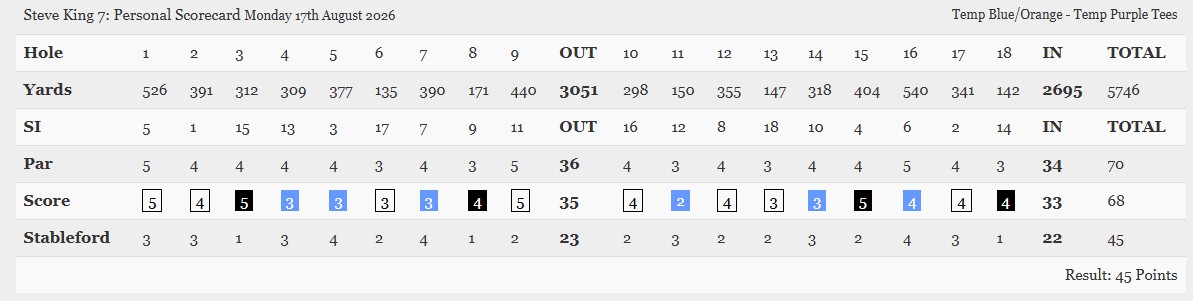
I have finally broken par for 18 holes, and in doing so I also broke 70 for the first time.
I have been close plenty of times before. There have been more rounds of one over par than I care to remember, along with occasions when I have been one or two under with only two or three holes remaining. The golf required to break par has been there for a long time. What I hadn’t managed to do was put it together for 18 holes and, perhaps more importantly, finish the job once I realised what I was about to achieve.
This isn’t really a post about shooting a good score, and I don’t particularly want it to read that way. Breaking par means something to me because it was difficult for me and because it took so long to achieve. Someone else’s equivalent might be breaking 100, 90 or 80, winning a first competition or achieving whatever golfing target has remained frustratingly out of reach.
For me, after approximately 25 years, it was breaking par.
Eventually, I did it.
I already had proof that the golf was there
One of the reasons breaking par had become frustrating was that I had plenty of evidence that I was capable of playing under-par golf.
One of my favourite examples came at Wrag Barn, where I played the back nine in four under par. It was an awesome nine holes of golf, but I remember being gutted afterwards because I had shot seven over on the front nine. I had managed to demonstrate two completely different versions of my game during the same round.
At Broome Manor, I once went five under par for a four-hole stretch. Going five under for any four holes takes some golf, yet somehow I managed to turn the complete round into six over par.
Then there was The Manor House. I stood on the 17th tee two under par with two holes remaining. I had already played 16 holes below par and was exactly where I needed to be.
I finished with two double bogeys and shot two over.
There have been other occasions when I have reached the closing holes one or two under, along with numerous rounds that have eventually finished one over.
Those rounds were frustrating at the time, but they have become useful evidence for me to call upon. I have played nine holes in four under. I have gone five under for four holes. I have stood on the 17th tee two under par. I have repeatedly played enough good golf during a round to threaten an under-par score.
The problem wasn’t proving that I could make birdies or play stretches of golf below par.
The missing part was joining enough of those stretches together and then getting out of my own way when I realised what was happening.
I had become very good at getting in my own way
There is a strange difference between playing well and knowing that you are playing well.
If I am one under par after six holes, there is plenty of golf remaining and I tend not to attach much significance to it. If I am one or two under standing on the 16th or 17th tee, suddenly every shot appears to carry more meaning.
That has caused problems for me in the past.
Instead of continuing to make the same swings and decisions that put me under par in the first place, I could become more conscious of everything. I would become aware of my score, sometimes physically stiffen up and start trying to protect what I had.
A normal iron shot was no longer simply an iron shot. It was the iron shot that might finally help me break par.
The physical task hadn’t changed, but I had changed the meaning attached to it.
I may have managed to break par sooner at Westbury under different circumstances, although there is little value in rewriting history. The greens there could beat me up, and because putting is comfortably the strongest part of my game, difficult-to-predict slow surfaces take away one of my biggest strengths.
Whatever the reasons, I never managed it there.
The milestone was still waiting when I moved to Cumberwell.
A fresh start at Cumberwell Park Golf Club
I recently left Westbury and joined Cumberwell Park, and one of the biggest differences I have noticed is how relaxed I feel there.
That may prove more important than anything technical.
I am enjoying learning the courses without feeling that I should already know exactly how to play every hole, and I have deliberately started by playing from the Purple tees, which were previously the Yellow tees.
That decision is part of this story and I think it is worth being completely open about it.
I had heard the suggestion that when joining or learning a new golf course, rather than immediately moving as far back as possible, it can be useful to start farther forward. It gives me an opportunity to understand where the trouble is, learn the angles into greens, work out which clubs are useful from particular positions and gradually build some course knowledge.
There was another part of the idea that particularly interested me.
Playing forward might help me learn how to shoot low.
Learning how to shoot low
There is an obvious difference between being physically capable of a low score and becoming comfortable when one is actually happening.
If I am regularly six or seven over par approaching the closing holes, I never get to practise the experience of protecting or extending an under-par round. There isn’t the same pressure attached to a five-foot putt or a club decision on the final tee.
Playing the Purple tees gives me more realistic birdie opportunities while I learn Cumberwell, but I still have to take those opportunities. More importantly, once I get under par, I have to learn how to remain there.
So far, the idea appears to be working.
I shot level par on the Yellow course from the Purple tees and followed that with two over par on the Orange course. I was becoming increasingly comfortable with the courses and with seeing lower numbers on the card.
Then came the round when everything finally joined together.
There will be plenty of time to move farther back as I become more familiar with Cumberwell. For now, I am learning the courses and learning what it feels like to shoot low.
After waiting approximately 25 years to break par, I don’t think that is a bad thing to practise.
Course management played its part
The conditions also had a significant influence on how I played the round.
The ground at Cumberwell was extremely hard and fast, with a huge amount of rollout available. That changes the effective length of the golf course and changes what I consider the sensible club from many tees.
I only hit driver four times during the entire round.
That wasn’t because I was frightened of my driver. I now have a driver that I trust. It was simply because driver wasn’t always the percentage play.
My Cobra F9 FW wood gave me plenty of distance in the conditions while making it easier to keep the ball in play. With the fairways running as quickly as they were, I didn’t need to hit driver simply because I happened to be standing on a par 4 or par 5.
That fits increasingly well with the way I want to play golf.
I don’t want to collect spectacular shots. I want to choose the shot with the highest probability of producing a good result and then commit fully to it.
The fact that I eventually made six birdies despite only hitting driver four times is a useful reminder that scoring and maximum distance aren’t the same thing.
Six birdies without realising there were six
One of the strangest things about the round was looking back afterwards and realising that I had made six birdies.
Obviously I knew each time I made one, but I wasn’t consciously keeping a running total of them. The round didn’t feel like some extraordinary birdie barrage while I was playing it.
I was simply playing golf.
That may have been important.
I wasn’t walking around thinking that this was finally the day. I wasn’t trying to manufacture birdies or suddenly attacking every flag because the score was good. I was choosing shots, making swings and moving on.
Six birdies doesn’t sound particularly boring, but they came from the sort of golf I have been trying to play. I was taking opportunities when they appeared rather than trying to force them.
By the time I reached the 16th tee, I was under par with three holes remaining.
I had been in similar situations before.
This time I needed to finish it.
The 16th started with my worst drive of the day
The 16th is a par 5 and I proceeded to hit my worst drive of the round.
That could easily have been the point where the old pattern started again. I was under par with three holes remaining and suddenly had a poor tee shot to deal with.
There was no point trying to recover everything with one heroic swing.
I hit a 6-iron back into play and left myself in a very good position overlooking the green. The third shot was downhill and I had recovered from the drive well enough to give myself another opportunity.
Then I fatted it.
It wasn’t a good shot, but golf occasionally gives something back.
The ball landed before the bunker, bounced over it and continued down the hill towards the flag. When it eventually stopped, I had approximately six feet left for birdie.
I rolled it in.
My worst drive of the day and a fat third shot had somehow produced a birdie.
The 17th wasn’t perfect either
This time I hit a great drive.
I followed it with another fat approach.
The ball still found the green, although I was approximately 40 feet from the hole. At that stage, two putts would have been perfectly acceptable.
My first putt went about five feet past and left me a downhill putt coming back.
Putting has always been the strongest part of my game and I am particularly comfortable over mid-range putts, but this one obviously carried a little more significance than most.
I made it.
Par.
The 18th was where I finally started thinking about it
The final hole was a short par 3 directly into the wind, with a low sun making the shot more awkward.
For perhaps the first time during those closing holes, I became noticeably indecisive.
I wasn’t completely comfortable with the club selection and eventually chose a 7-iron, effectively taking one more club than I thought the basic yardage required. The plan was to get the ball onto the green and trust my putting.
That was a perfectly sensible strategy. If I could find the putting surface, I was backing the strongest part of my game to finish the round.
I didn’t find it.
The 7-iron came up short, caught the bank and rolled back down. I was left with an awkward shot of roughly 12 feet to the hole but with a five or six-foot hill immediately in front of me.
Normally I would assess whether chipping or putting gave me the highest percentage of getting the ball close.
This time I could feel that I had moved into damage-limitation mode.
I had lost some confidence in the shot and chose to putt rather than chip. I hit it slightly too firmly and watched the ball run approximately eight feet past the hole.
That left an eight-foot putt, downhill and moving from left to right.
I hit a good putt.
missed
Bogey.
Disappointed and elated at exactly the same time
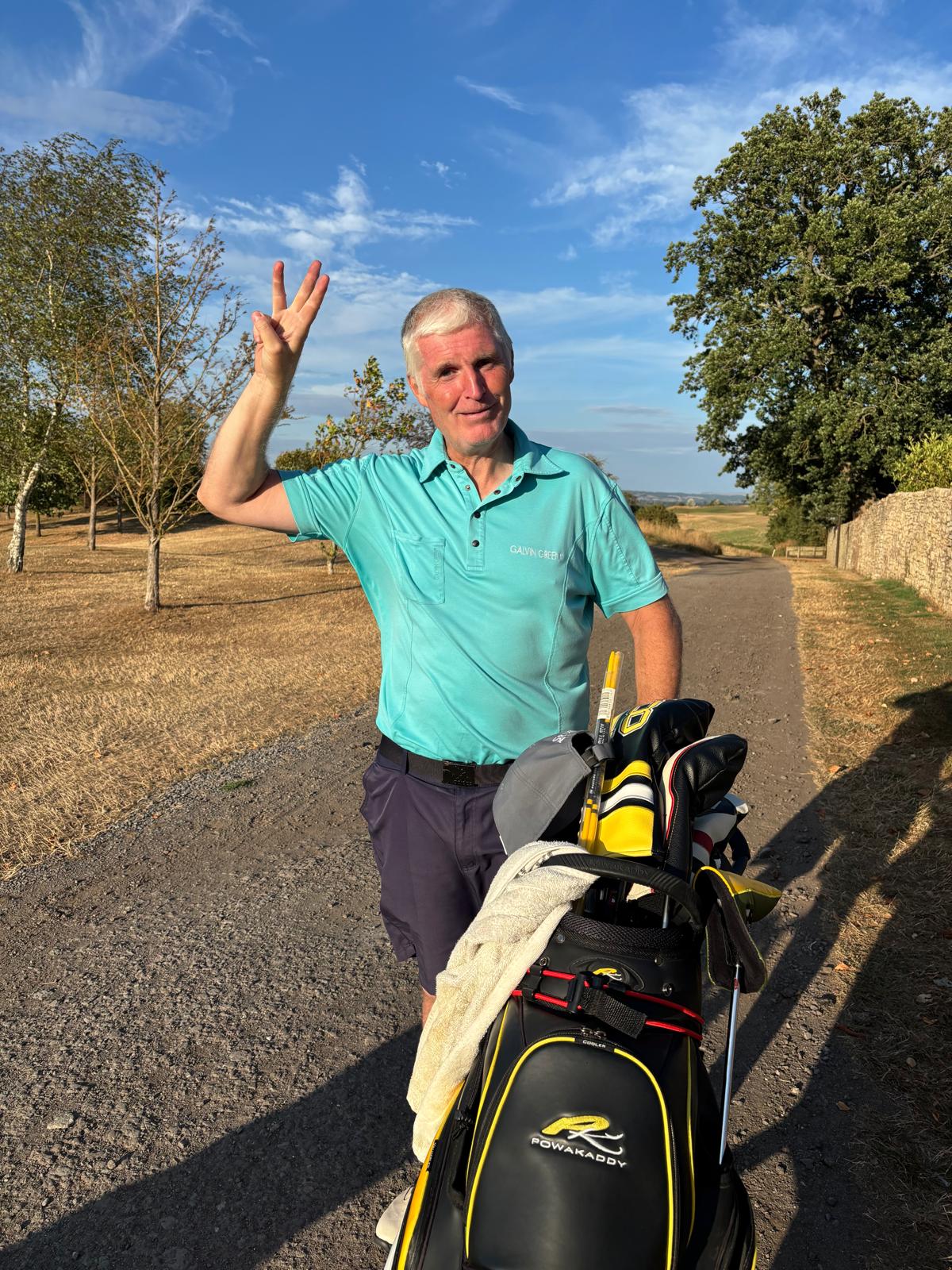
My immediate reaction was a strange mixture of disappointment and elation.
I had just broken par for the first time in approximately 25 years of playing golf.
I had also broken 70 for the first time.
Yet I had stood on the final tee three under par and then promptly made bogey.
Part of me was delighted with what I had finally achieved, while another part was inevitably thinking about the shot I’d just given away.
That is probably a fairly typical golfer’s reaction.
With a little distance from the round, though, I actually think the imperfect finish makes the achievement more useful.
I didn’t finally break par by reaching the closing holes and producing a succession of perfect golf shots.
Quite the opposite.
I didn’t need perfect golf to finish it
On the 16th I hit my worst drive of the day and fatted my third shot. On the 17th I hit a good drive and then fatted another approach. On the 18th I became indecisive, missed the green, lost some confidence around the green and eventually made bogey.
There were plenty of opportunities for the round to disappear.
The difference this time was that a bad shot didn’t automatically produce a sequence of bad decisions.
After the poor drive on 16, I played a sensible 6-iron back into position. The third wasn’t good, but I accepted the fortunate result and made the putt.
After the poor approach on 17, I accepted the 40-footer and dealt with the uncomfortable putt coming back.
Even after making a mess of the 18th, the damage was limited to one shot.
That is probably a much more realistic version of closing out a good round than the one I had imagined for years.
I had always pictured finally breaking par as a round where I reached the final few holes and calmly hit every shot exactly where I wanted.
Instead, I simply dealt with the mistakes well enough to get over the line.
The 18th still taught me something
I don’t want to pretend that I am completely satisfied with the final hole simply because the overall score was good.
There is something useful in what happened.
The indecision over club selection was probably the first warning sign. I had spent most of the round playing the golf course, but on the 18th I became more aware of the situation.
After missing the green, my thinking changed again. Instead of simply assessing the lie, the obstacles and the highest-percentage shot, I became concerned with avoiding disaster.
There are plenty of situations where damage limitation is exactly the correct strategy, but there is a difference between sensible conservatism and tentative golf.
I think I crossed that line slightly.
The positive is that the next time I stand on a final tee with an under-par round to finish, I will have been there before.
Breaking par is no longer an unfamiliar situation.
I have finished one.
Chris Tyson has helped me build something I can trust
Chris Tyson deserves credit for helping me reach this point.
He has helped me build a better golf swing, but perhaps more importantly he has helped me develop a process I can return to when the swing isn’t behaving itself.
I think that distinction matters.
I don’t expect to reach a point where I never hit the ball badly again. Golf doesn’t work that way. What I have is an understanding of what I am trying to do and somewhere sensible to return when things start going wrong.
That creates trust.
A poor spell doesn’t automatically require another swing theory or a complete rebuild. I have a process.
Over the years I had already accumulated enough evidence to know that my golf could be very good in bursts. Chris has helped me make the underlying swing more dependable and given me something I can return to when it isn’t.
That has undoubtedly played a part in getting me to this point.
Then I had another lesson and hit it badly
A few days after breaking par, I had another lesson with Chris and hit the ball badly.
In some ways, I couldn’t have scripted a more appropriate follow-up.
I had just achieved two of the biggest scoring milestones of my golfing life and then turned up for a lesson almost unable to hit the ball.
It was a useful reminder that breaking par hadn’t suddenly transformed me into a different golfer.
The weaknesses are still there. There are still things Chris and I can work on, and there will still be rounds when my swing doesn’t feel particularly good.
I actually find that reassuring because it puts the achievement into perspective.
I didn’t finally break par because, after 25 years, I had discovered a perfect golf swing.
I did it with the game I already had, including all of its imperfections.
This isn’t about bragging about a score
There is always a slight awkwardness in writing about a personal best because I don’t particularly want to publish a post whose only message is that I shot a good score.
That isn’t why I wanted to write this.
I’ve been playing golf for around 25 years and it took me that long to break par. During those years I have practised, had lessons, got close repeatedly, thrown away good positions and occasionally played extraordinary stretches of golf inside otherwise ordinary rounds.
Wrag Barn gave me a back nine of four under.
Broome Manor gave me a four-hole stretch of five under.
The Manor House gave me the experience of standing on the 17th tee two under.
The numerous one-over rounds gave me repeated evidence that the gap wasn’t particularly large.
None of those experiences disappeared because the final score wasn’t what I wanted.
They were proof that the golf existed.
This round finally gave me proof that I could put enough of it together and finish.
Practice, belief and learning to relax
If there is anything I want another weekend golfer to take from this, it isn’t that they should compare their score with mine.
Breaking par means something to me because it was difficult for me.
For somebody else, the equivalent might be breaking 100, breaking 90, breaking 80, making a first birdie, winning a first competition or simply getting through a round without the particular mistake that has been frustrating them for years.
The number isn’t really the point.
The process is.
I have practised. I have had coaching. I have made changes to the way I think about course management. I have tried to build a golf swing I can trust and a process I can return to when it isn’t working.
I have also become increasingly aware of how much better I play when I am relaxed.
Moving to Cumberwell seems to have helped enormously with that.
Playing the Purple tees while learning the courses has helped too. It is giving me opportunities to make birdies and experience being under par rather than treating a low score as some rare situation that I don’t know how to handle.
I am beginning to think that learning how to shoot low is itself something that can be practised.
The physical golf obviously still matters. I have to hit the shots and hole the putts.
But there is also something useful about standing on the 16th tee three under par and discovering that nothing fundamental has changed.
It is still a tee shot.
I still need to choose a target, select the right club and make a committed swing.
I didn’t handle every moment perfectly this time.
I handled enough of them well enough.
After 25 years, that was finally enough.
That barrier has gone
I don’t know what the next milestone will be, and I certainly don’t assume that one round means I am suddenly going to shoot in the 60s every week.
Golf dealt with any danger of thinking that almost immediately when I went for the lesson with Chris and struggled to hit it properly.
What I do have now is proof.
The back nine at Wrag Barn, the run at Broome Manor and those closing holes at The Manor House were all evidence that I possessed the golf required to play below par.
This round was different.
This time I finished it.
It took approximately 25 years, plenty of practice, help from Chris, a lot of near misses, some better course management, belief that the golf was there and probably learning to relax a little more.
I would still like the putt back on the 18th.
I’ve already said to myself, imagine if I had birdied 18 instead of bogeying it
I’m a golfer, so I suspect that part will never change.
But for approximately 25 years, breaking par was something I believed I was capable of doing.
Now I know.
Whatever score or milestone someone else has been chasing, that is probably the part of this story worth taking away.
Keep practising, keep believing, learn from the rounds where it doesn’t quite happen and give yourself another opportunity.
Sometimes it takes longer than you expect.
Keep going.