
I once made 11 on the second hole of a round at Westbury Golf Club.
It was a par 4.
Westbury is a par-70 course, so an 11 on the second hole is a pretty efficient way of making a good score look very difficult.
Yet I still shot 75.
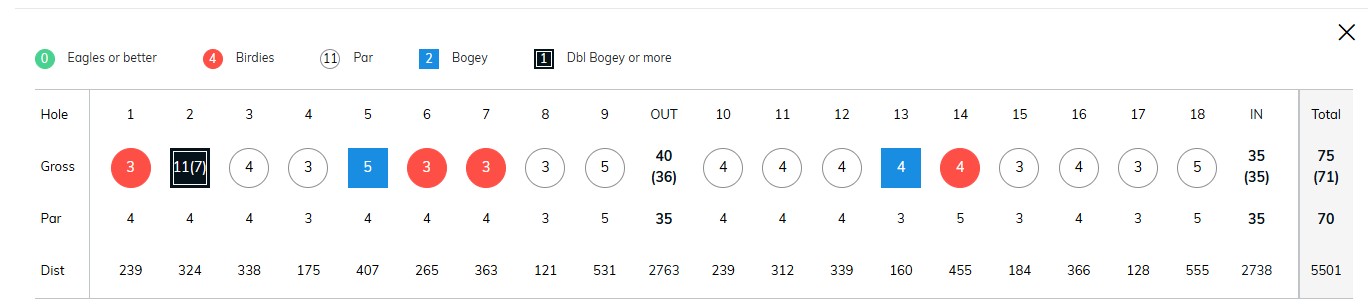
My front nine was 40, my back nine was 35, and I made four birdies during the round. Most importantly, after making 11 on the second hole, I played the remaining holes under par.
I think about that round quite often because it taught me something I hadn’t fully understood before.
A bad hole doesn’t necessarily ruin a round.
What can ruin the round is what you decide to do afterwards.
How I Made 11 and Still Recovered to Shoot 75
The 75 is the headline, but the scorecard tells the story much better.
I started the day by putting an 11 on the card.
Then I shot the rest of the front nine well enough to turn that into 40.
On the back nine I went even better, shooting 35.
There were four birdies in the round.
So when I look back at it, I don’t really see an 11 followed by a miraculous recovery. I see one terrible hole followed by a lot of ordinary golf played reasonably well.
That distinction matters.
There was no six-birdie stretch where I suddenly discovered some secret version of my golf game.
I simply carried on playing.
Don’t Try to Get the Shots Back After a Bad Hole
I think this is one of the easiest traps to fall into after a disaster hole.
You make a big number and immediately start doing the maths.
I’ve just thrown away four shots.
I need to make birdie here.
I need to get one back.
I need to make up for that.
And suddenly the next tee shot isn’t really about the next tee shot at all.
It’s about the previous hole.
That is a dangerous place to play golf from.
There is a useful distinction here between trying to score and trying to recover a score.
I don’t think those are the same thing.
After making 11, I wasn’t going to get those shots back on the next hole. They were already on the card.
The only shots available to me were the ones I hadn’t played yet.
That sounds obvious.
In the middle of a round, it isn’t always obvious.
Why a Bad Hole Can Sometimes Take the Pressure Off
Looking back, I think the 11 actually removed some pressure.
That sounds slightly ridiculous, but it made sense to me at the time.
Normally, when I’m playing a very good round, the score can start becoming more noticeable.
I’ve had rounds where I’m approaching a personal best or getting close to breaking par and I become increasingly aware of what the score might mean.
I have physically stiffened over shots.
I’ve thrown shots away because I was thinking about the round rather than playing the shot.
That is still something I’m working on.
Decision-making, course knowledge, maintaining a good pre-shot routine and staying fully in the moment are all areas I know I can improve.
But after an 11 on the second hole, there was much less to protect.
The score had already been damaged.
Perhaps that made it easier to play.
I wasn’t standing on the third tee thinking, Don’t ruin my good round.
There wasn’t a good round to protect.
There was just another golf hole to play.
How to Recover From a Bad Hole in Golf
This is where my general approach to golf comes into it.
I try to pick conservative targets but be aggressive in execution.
I don’t mean conservative as in timid.
I mean choosing a target that gives me a sensible margin for error, then actually committing to the shot I’ve decided to play.
That philosophy becomes particularly useful after something goes wrong.
If I’ve just made an 11, I don’t think the answer is suddenly to start aiming at impossible places or attempting shots I wouldn’t normally play.
Quite the opposite.
I want to make sensible decisions.
Get the ball into play.
Choose the sensible target.
Commit to the shot.
Then do it again.
And again.
My natural tendency in trouble is actually quite conservative. I would rather get the ball back into play and trust my short game and putting than try a heroic recovery.
That doesn’t mean I always do it perfectly.
But it is the approach I trust.
Don’t Let One Bad Hole Become Three
One of the things I think golfers misunderstand about recovering from a bad hole is that recovery doesn’t have to happen immediately.
You don’t have to make birdie on the next hole.
You don’t even need to make par.
You need to stop the bad hole becoming three bad holes.
That is a much more manageable objective.
Once you stop thinking about getting shots back and start thinking about playing the next hole well, something changes.
You’re no longer chasing the score.
You’re simply giving yourself another opportunity.
That is what happened to me at Westbury.
The 11 stayed on the card.
I didn’t erase it.
I just stopped adding to it.
How I Got My Golf Round Back on Track
This is probably the biggest lesson I took from the round.
Scores can repair themselves.
You don’t necessarily have to force them back.
My front nine was 40, which isn’t going to look spectacular if you simply read the number.
But after making 11 that early, it meant I’d played the other eight holes of the front nine in two under par.
That was solid.
Then I shot 35 on the back nine.
The score gradually came back because I kept putting myself in positions where decent holes were possible.
That’s a very different mindset from thinking, I have to shoot three under from here.
One approach asks me to control an outcome I can’t control.
The other asks me to play the next shot properly.
I know which one I find easier to trust.
Golf Course Management After a Bad Hole
Course management is sometimes presented as a collection of rules about which club to hit from which situation.
I think there is more to it than that.
It is also knowing what the state of the round means for your decisions.
If I am striking the ball well and need to chase, I might take an aggressive decision.
If I am playing well and need to protect a score, I might make a different decision.
That’s something I already think about with par 5s, for example. How I’m playing that day and the state of the round both affect whether I chase or protect.
After an 11, I didn’t need to manufacture excitement.
I needed to give myself chances.
That is course management as I understand it.
Not eliminating mistakes.
Giving yourself the best chance of responding sensibly when mistakes inevitably happen.
How to Stay Patient After a Bad Hole
Before that round, I think I understood patience intellectually.
After it, I understood it a little better as a golfer.
Patience isn’t standing on the next tee telling yourself everything is fine.
You know it isn’t fine.
You’ve just made 11.
Patience is accepting that the hole happened, accepting what is now on the card, and refusing to make a second mistake because you are angry about the first one.
That is a much more practical definition.
You don’t have to feel calm.
You don’t have to suddenly become some kind of zen golfer.
You just have to make the next decision based on the next shot rather than the last one.
Why the Mental Side of Golf Is Still Difficult for Me
I don’t want to turn one good recovery into a claim that I’ve mastered the mental side of golf.
I haven’t.
My own biggest improvement areas still include staying in the moment, maintaining a proper routine and making better decisions.
And the irony of that 11 is that it was easier in one respect because the score was already damaged.
Some of my harder moments have come when the score is going really well.
When I’m close to a personal best, I can become too aware of what I’m doing.
The swing gets tighter.
The routine changes.
I stop playing the shot and start playing the score.
I’ve done that.
So I don’t think the lesson is that I’ve suddenly found the secret to staying calm under pressure.
The lesson is much simpler.
I’ve seen, for myself, that a score can survive far more damage than I sometimes think it can.
Focus on the Next Golf Shot, Not the Last One
If you make a 9, 10 or 11, that number can feel like the whole round is finished.
It isn’t.
And even if the round does end up being disappointing, there is no benefit in making the next few holes worse because you’re angry about what happened.
The 11 at Westbury was already enormous.
There was nothing I could do about it.
What I could do was play the third hole.
Then the fourth.
Then the fifth.
By the time I got to the back nine, I wasn’t trying to prove anything about the 11 anymore.
I was just playing.
And that produced a 35.
What to Do After a Bad Hole in Golf
I wouldn’t pretend I have a magic reset routine.
But my thinking would be fairly simple.
Accept the score.
Forget about getting the shots back immediately.
Pick a sensible target.
Commit to the next shot.
Then do the same thing again.
I would also resist the temptation to suddenly rebuild my swing because one hole went badly.
A bad hole does not automatically mean something is fundamentally wrong with your golf swing.
Sometimes a hole just goes badly.
Even when the mistake is yours, the useful question is usually what decision you need to make next.
That fits with something I’m still trying to get better at in my own game: staying in the present rather than allowing one shot to influence the next one.
[Play Golf Between the Ears] in the free Weekend Golfers Coaching Library is the natural place to go alongside this if you want more structured work on decision-making, focus, expectations and playing under pressure.
What Shooting 75 After Making 11 Taught Me
I don’t look at this round and think, What an amazing comeback.
I think it was a useful reminder of what golf actually allows you to do.
I made 11 on the second hole.
I still shot 75.
The front nine was 40.
The back nine was 35.
There were four birdies.
And I played the remaining 16 holes under par.
The most interesting number isn’t really the 11 or the 75.
It’s the three under par.
That was what happened when I stopped trying to repair the previous hole and simply carried on playing.
I don’t think there is a great mystery to it.
You cannot change the score you’ve already written down.
You can only influence the next shot.
So when you have a disastrous hole, perhaps the job isn’t to rescue the round.
Perhaps the job is simply to stop the disaster spreading.
The score may come back by itself.