
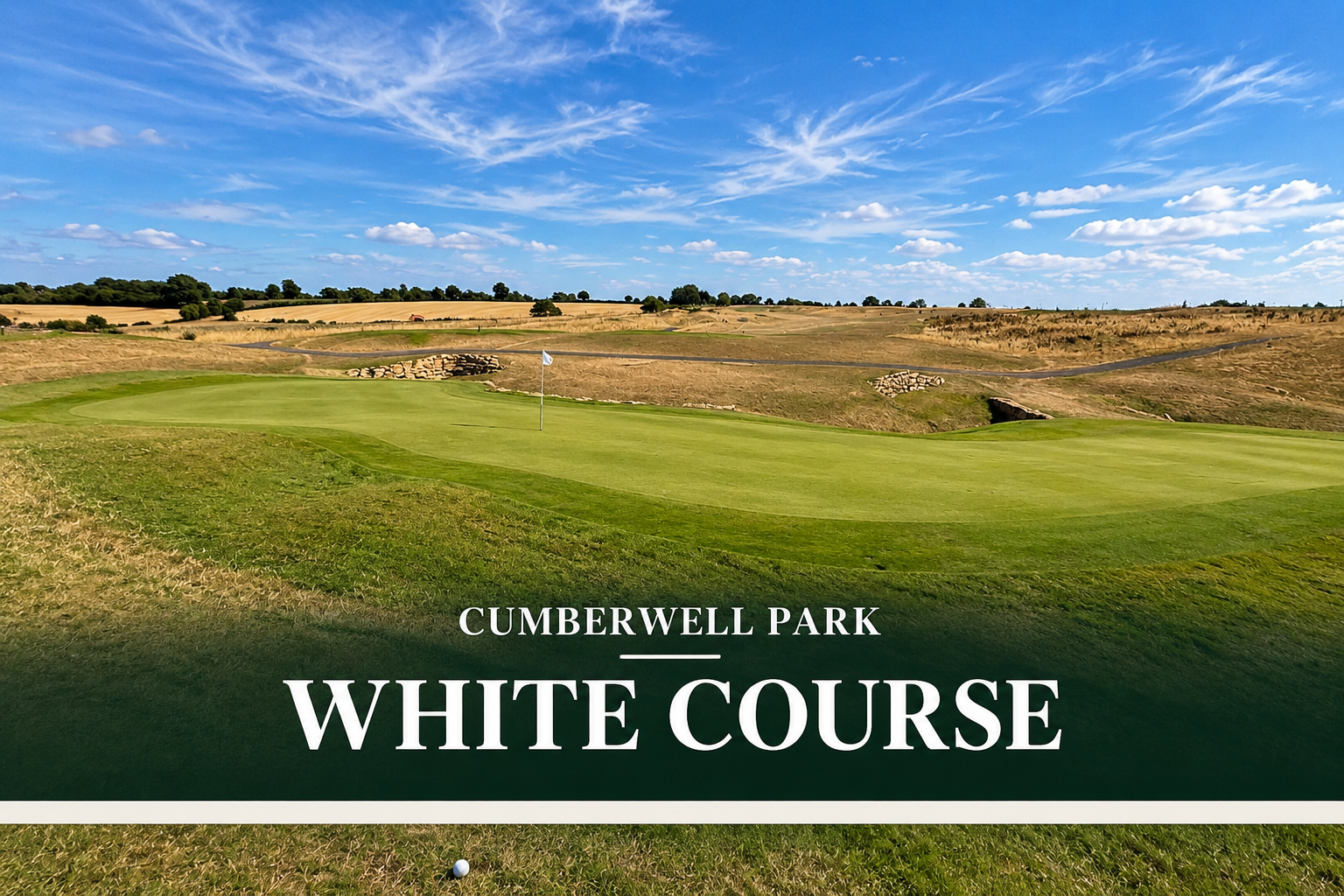
The White Course is the newest addition to Cumberwell Park and feels noticeably different from the club’s older courses.
The first nine holes opened in 2023, with a second nine currently under construction. That makes White the course at Cumberwell that is still developing, rather than one I’ve known for years like Red, Yellow, Blue and Orange.
The course is more open in places and has its own character, with large greens, changes in elevation and some very different views across the Cumberwell estate.
I’m still getting to know White, which is part of what makes playing it interesting. Rather than relying on years of familiarity, I’m still working out where to hit it, which lines actually work and which holes aren’t quite as straightforward as they first appear.
Play the White Course Hole by Hole
Hole 37 Par 4

The White Course starts with a short par 4 and plenty of room from the tee, although I prefer to favour the right side.
Driver can bring the back of the hole into play. I’ve already managed to hit through the back with a few.
At the moment I’m taking a much more conservative approach with a 3-iron towards the front of the green and then pitching or chipping on.
The green is wide but relatively shallow as you look at it from the fairway, so distance control on the approach matters.
It’s a good example of a short par 4 where getting closer to the green isn’t necessarily making the next shot easier.
Hole 38 Par 5

The second is a short par 5 with a slightly blind tee shot.
The first time I played it, I hammered a drive down the left side and never found the ball again.
I’ve changed the way I play it since then and now hit an iron towards the stones on the right side of the fairway.
From there you’re left with a downhill approach of around 200 yards. A small brook runs in front of the green, while the green itself has enough slope to catch you out even after you’ve safely negotiated the water.
It’s a hole where birdie is very achievable, but bogey can arrive just as easily.
Hole 39 Par 4

The third is an uphill par 4 where I prefer to favour the right side of the fairway from the tee.
From there, a good drive should leave a mid to short iron for the uphill approach into the green.
The green itself is quite large, so simply finding it isn’t necessarily enough. Pace control and reading the slopes properly become important if you want to avoid turning a decent approach into a three-putt.
Hole 40 Par 3
The fourth is a par 3 that changes considerably depending on which tee you’re playing.
From the forward tees it can be relatively straightforward, while moving back changes both the distance and the angle into the green. Either way, you still need to hit a decent shot into a raised green.
Come up short and you’re likely to leave yourself an awkward chip or pitch from below the putting surface.
The green also has plenty of places to position the flag and make the hole considerably more difficult than the yardage might suggest.
Hole 41 Par 4

The fifth is a medium-length par 4 with a blind tee shot.
I prefer to favour the left side from the tee and let the contours do some of the work, with the fairway naturally moving the ball from left to right.
The green is large but has plenty of slopes, so finding it in regulation doesn’t necessarily guarantee an easy two-putt. Where you leave the approach can make a big difference.
Hole 42 Par 4

The sixth is a par 4 where the fairway bunker on the right, around 220 yards from the tee, gives you a decision to make.
You can play left of it, although going too far that way risks running off the fairway into the rough. You can try to carry the bunker and bring it directly into play, or lay back and accept a much longer approach.
Whichever option you choose from the tee, there’s still another sloping green waiting at the other end.
Hole 43 Par 4
The seventh is a driveable par 4 with a fairway that slopes from left to right.
For anyone who naturally hits a slice, there’s plenty of opportunity to keep moving right.
Higher-handicap golfers can sometimes be found on the 3rd fairway, leaving themselves an uphill shot back towards the green.
I’ve driven the green a few times, but recently I’ve been playing the hole differently. I’m working on hitting a long iron from the tee and leaving myself a wedge that I can try to flight low and spin.
It’s a long green, so judging the approach distance is part of the challenge, particularly as my Bushnell sat nav doesn’t currently have the White Course mapped.
Hole 44 Par 4
The eighth is a short par 4 that doglegs from left to right.
The first time I played it, I knew it was only around 320 yards but the flag looked about 400 yards away to me. My eyesight isn’t the best, so I ended up bumping a driver down the middle.
Once I reached the ball and could actually see the shape of the hole, I realised how much of the corner you can potentially take off. You need enough carry, though, or the more aggressive line simply leaves you in the rough.
At the moment I’m playing rather more boring golf: 5-iron, wedge and rely on the putter to give me a chance of birdie.
The green has a significant tier towards the back, so getting the approach onto the correct level matters.
There’s another challenge when playing late in the day. The setting sun can be directly in your eyeline from the tee, something I’ve never been particularly good at dealing with.
Hole 45 Par 3
The White Course finishes with a fairly gentle par 3, with a bunker protecting the front-right of the green.
I’ve found this one pretty straightforward. Take enough club to reach the back of the green and there isn’t too much trouble to worry about.
The different tees change the angle slightly, but most of the danger is right there in front of you.
There aren’t really any hidden surprises. Hit a decent shot and it gives you a good opportunity to finish the nine with a par or better.