
Golf gives you an almost endless number of shots to learn.
You can work on high fades, low draws, flop shots, stingers, spinning wedge shots and all sorts of clever little shots around the green. I can deliberately hit a draw and a fade myself, and there are times when being able to manufacture something unusual is useful.
But if I were helping an ordinary weekend golfer decide where to spend limited practice time, none of those shots would be near the top of my list.
I would start with five much less glamorous shots:
- A lag putt
- A mid-range putt
- A chip-and-run
- A tee shot with a driver
- A pitch shot with good distance control
That is my list.
It isn’t supposed to cover every situation you will face on a golf course, and I am not claiming these are universally the five most important shots for every golfer. I am a Weekend Golfer, not a PGA professional.
But these are the shots I think an ordinary golfer gets asked to play often enough that becoming dependable at them can make a real difference.
The important word there is dependable.
Why I would learn these shots before anything clever
My general approach to golf is to pick conservative targets but be aggressive in execution.
That doesn’t mean playing scared golf. It means giving myself a sensible shot and then committing to it.
The same thinking applies here.
I would rather have five ordinary shots that I trust than fifteen impressive shots that occasionally come off.
When I get into trouble myself, my instinct is normally to get the ball back into play and trust my short game and putting rather than attempt the heroic recovery. Around a green, I am looking at the lie, the distance, what is between me and the hole and where I want the ball to land before deciding what shot gives me the best chance of clean contact and an acceptable result.
That isn’t as exciting as opening a 60-degree wedge and trying to land the ball beside the flag.
It tends to be rather more useful.
These five shots follow the same principle. They aren’t selected because they look good. They are selected because you can need them repeatedly during an ordinary round of golf.
1. The lag putt
If I could give a high-handicap golfer a substantial improvement in one part of their putting without changing their stroke, I would be very interested in their pace control.
Putting is comfortably the strongest part of my own game, and I think high handicappers spend too little time learning how hard to hit putts.
A long putt is a good example.
Of course I am trying to hole it. I don’t stand over a putt intending to miss.
But from serious distance, the practical job is to control the speed well enough that a miss leaves a straightforward second putt.
That changes the challenge.
You don’t need to become brilliant at holing 40-footers. You need to become good at not turning 40 feet into another difficult putt.
I am naturally a dead-weight putter. I like the ball arriving at the hole with relatively little pace, and when I get it right my misses tend to finish close enough that I am not constantly fighting awkward comeback putts.
That becomes particularly valuable on fast, undulating greens, which are the greens I enjoy most.
What I would actually practise
I wouldn’t spend the whole session hitting the same long putt from the same place.
I would change the distance.
Hit one from 20 feet, another from 30, another from 40. Move uphill and downhill. Give yourself different amounts of break.
The skill I want to develop is not memorising one stroke. It is looking at a putt, reading what is in front of me and producing an appropriate pace.
Count the good outcomes by where the ball finishes, not by whether the occasional long one drops.
If your first putt repeatedly finishes in a comfortable area around the hole, your lag putting is doing its job.
If pace control is an area you want to work on, Putt For Dough in our Coaching Library includes PGA coaching on putting fundamentals, pace control, green reading and practice drills.
2. The mid-range putt
Long putting is largely about avoiding unnecessary damage.
Mid-range putting gives you the chance to do some damage of your own.
Six feet happens to be a distance I particularly like. That is personal to me, not a number I think every golfer should adopt. I stand over a six-footer expecting to hole it.
I want more weekend golfers to develop their own version of that feeling.
It might be four feet. It might be five. It might eventually be eight.
The exact distance matters less than having a range where your first thought is not, I hope I don’t miss this.
There is also an important connection with the first shot on this list.
If you become a good lag putter, you leave yourself fewer difficult second putts. If you then become confident from the sort of distance that does remain, the two skills start supporting each other.
That can change how putting feels over an entire round.
Read the putt properly first
One thing I think high handicappers get wrong is not giving the read of the putt enough attention.
They walk onto the green, have a quick look and hit it.
I wouldn’t separate becoming a better putter from becoming a better reader of greens. Pace and break belong together.
I caddie for a professional, and one thing that has reinforced for me is how much care good players give to what the ball is actually going to do.
You can make a lovely stroke on the wrong line and miss.
You can read it correctly and hit it at the wrong pace and miss.
So when I talk about learning a six-foot putt, I don’t just mean learning a putting stroke. I mean learning the whole job.
Read it. Choose the line and pace. Commit to it.
Then hit the putt as though you expect it to go in.
There is more structured PGA coaching on putting technique, green reading and practice in Putt For Dough in the Weekend Golfers Coaching Library.
3. The chip-and-run
If there is one shot on this list that represents how I think about golf, it might be the chip-and-run.
Get the ball safely onto the green and let it roll.
Simple.
I regularly use a 7-, 8- or 9-iron for this shot when the situation suits it. I don’t automatically reach for a lofted wedge just because I have missed a green.
My decision starts with the lie.
Then I look at the distance, anything I need to get over, the landing area and the trajectory I want. Only then do I choose the club.
Sometimes that leads me to my 46, 52 or 58-degree wedge.
Sometimes it leads me to an iron and a chip-and-run.
The question I am really asking is:
What gives me the highest-percentage chance of clean contact and an acceptable result?
That is much more useful to me than deciding in advance that I am a golfer who chips with a particular club.
Why I prefer the simpler option when it is available
Every extra bit of height you ask for introduces another demand.
Sometimes you need that height. If I have to play a flop shot, I will play one.
But I don’t play one for entertainment.
If there is plenty of green between me and the flag and nothing forces me to throw the ball high into the air, I am very happy to keep it lower.
I think this is where some golfers can make the game unnecessarily difficult.
The objective isn’t to produce the prettiest shot.
The objective is to play the next shot from somewhere better.
Practise the landing point, not just the swing
A useful chip-and-run practice session for me would involve changing clubs and learning what happens after the ball lands.
Take a 7-iron, 8-iron and 9-iron and play towards the same hole.
Notice how far each one carries and how far it rolls.
Then change the landing point.
You are learning to solve a golf problem rather than trying to manufacture one perfect chipping action.
If you want to work on the technique rather than just my approach to choosing the shot, Short Game Secrets in the Weekend Golfers Coaching Library covers the fundamentals of chipping and pitching.
4. The tee shot with a driver
This one might appear to contradict everything I have just said about conservative golf.
It doesn’t.
I am perfectly happy to leave my driver in the bag.
My Mizuno MP20 3-iron goes around 200 yards and is a club I trust as a fairway-finder. On a tight par 4, I can quite happily hit that from the tee if I think it gives me the better route through the hole.
But I still think a weekend golfer should learn to hit a driver.
Why?
Because distance is useful.
There are plenty of holes where getting the ball well down the fairway gives you a much easier second shot. Avoiding driver completely because you don’t trust it takes an important option away from you.
My normal driver swing is around 104 mph and my stock Cobra SpeedZone flight is medium height. I generally carry it around 230 to 240 yards, with total distance varying considerably with the ground conditions.
At the moment my miss is more often left than right.
None of those numbers particularly matter to another golfer.
What matters is that I know what my normal driver shot looks like, roughly how far it goes and where my current miss tends to be.
That information helps me make a decision.
Learn your driver, don’t chase somebody else’s
I wouldn’t define learning the driver as learning to hit it 280 yards.
For one golfer, success might be a 190-yard shot that stays in play most of the time. For another it might be 250.
I would want to know three things:
What is my normal shot?
How far does it actually go?
Where does my bad one normally go?
Once you know those things, you can start using the driver as a golf club rather than treating it as a test of your swing.
That is where my conservative-target, aggressive-execution idea matters.
Choose a target that gives your normal shot and normal miss some room. Then make the swing properly.
Standing on the tee trying to steer a driver into the fairway is not my idea of conservative golf. It is an uncommitted swing at a conservative target.
Those are not the same thing.
For the technical side of becoming more consistent off the tee, Drive For Show in the Coaching Library provides the PGA coaching that complements how I think about using the driver on the course.
5. The pitch shot, particularly distance control
The last shot on my list is the pitch.
More specifically, I want a golfer to be able to stand 30, 40, 50 or 60 yards from the green and have some idea how they are going to make the ball travel the required distance.
That awkward area between a little chip and a comfortable fuller wedge can expose a lot of golfers.
It can expose me as well.
I have recently changed from Callaway XR Pro irons to Mizuno MP18 SC irons and I have been relearning my carry distances. I generally know my numbers, but like plenty of amateurs I still miss short more often than I miss long.
That matters because distance control isn’t just about knowing that a particular wedge goes a particular distance with a full swing.
Golf keeps giving you distances that don’t match your full swings.
I want a predictable result, not a fancy wedge shot
My wedges are currently 46, 52 and 58 degrees.
Around the green I choose between them according to the shot. With pitches, I want the same basic freedom to choose the club and flight that make the distance easiest to produce.
I generally prefer seeing a wedge fly a little lower rather than throwing everything high.
But again, that is my preference rather than a rule I would impose on somebody else.
The important thing is developing some repeatable reference points.
If you have a swing and club combination that normally carries the ball 40 yards, that is useful.
If another carries 55, that is useful.
Build enough of those references and suddenly a pitch shot stops being, somewhere between a chip and a full swing.
You have something to work from.
Don’t practise every pitch from the same distance
This is another area where I think practice should look more like golf.
I don’t particularly enjoy standing on a range hitting huge numbers of balls. I normally limit myself to around 30.
I would rather make those balls count.
With pitching, I would pick different targets and make myself change distance. Hit one 30 yards, one 45, one 60. Change club occasionally. Change trajectory if there is a reason to.
On a golf course you don’t get to hit eight 50-yard pitches until you have found the right swing.
You get one.
Practise accordingly.
Short Game Secrets also covers pitching, so that is the natural next place to go if you want structured coaching alongside this approach to practising distance control.
What isn’t on my list
There is no bunker shot.
No flop shot.
No deliberate draw or fade.
No punch shot.
No long iron.
That doesn’t mean those shots are unimportant.
I am currently relearning my own bunker play after moving from Westbury to Cumberwell. The bunkers have much more sand, and my current 58-degree Cleveland wedge has more bounce than the 60-degree Vokey I was previously using.
At the moment, when I get into some of those bunkers, I am not thinking about producing a beautiful splash shot that lands on a precise spot.
My first job is getting the ball out.
That is golf.
Sometimes the standard of shot you need right now is simply one that removes the immediate problem.
Over time I can improve it. Then I can become more ambitious with the landing point and distance control.
But I don’t think golfers need to wait until they have accumulated a complete collection of golf shots before they can score better.
They need a few shots they can trust.
If I only had a limited amount of practice time
I would build practice around situations rather than trying to fix everything at once.
I would hit long putts to different holes and judge success by the second putt I had left.
I would hit mid-range putts with the intention of holing them.
I would practise chip-and-runs with several clubs and different landing spots.
I would hit enough drivers to understand my normal flight and current miss.
And I would hit pitches to changing distances rather than repeatedly firing balls at one target.
That is already a lot of golf.
More importantly, all five skills transfer directly to situations you are likely to face when you actually play.
I have recently moved to Cumberwell, where the practice facilities are much better than I had at Westbury, and one of the ideas I want to keep testing in my own practice is simple:
Practise golf, not just the golf swing.
There is a difference.
Dependable beats impressive
I like good golf shots as much as anybody.
I enjoy shaping a ball when the situation calls for it. I enjoy attacking a flag. In fact, one of my own weaknesses is that I can be drawn towards flags almost without thinking about it, like a moth to a flame.
But the older and more experienced I get as a golfer, the less convinced I am that adding more shots is automatically the route to lower scores.
I once made an 11 on the second hole at Westbury and still shot 75 on a par-70 course.
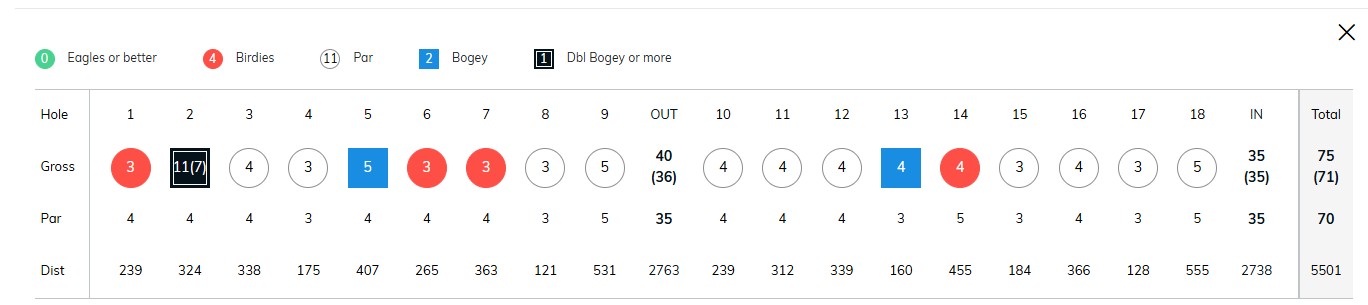
There wasn’t a magic recovery shot that rescued that round.
I had to accept what had happened, keep playing and be patient enough to let the shots come back.
I think the same principle applies to learning the game.
You don’t need every shot.
You need enough dependable ones to keep putting yourself in positions where a decent score is still available.
For me, I would start with these five.
Get the long putts close.
Expect to hole the makeable ones.
Get the chip safely onto the green and rolling when the situation allows it.
Learn to put a driver in play when distance is worth having.
And learn how far your pitch shots actually fly.
After that, by all means learn the clever stuff.
You might find you need it rather less often than you thought.